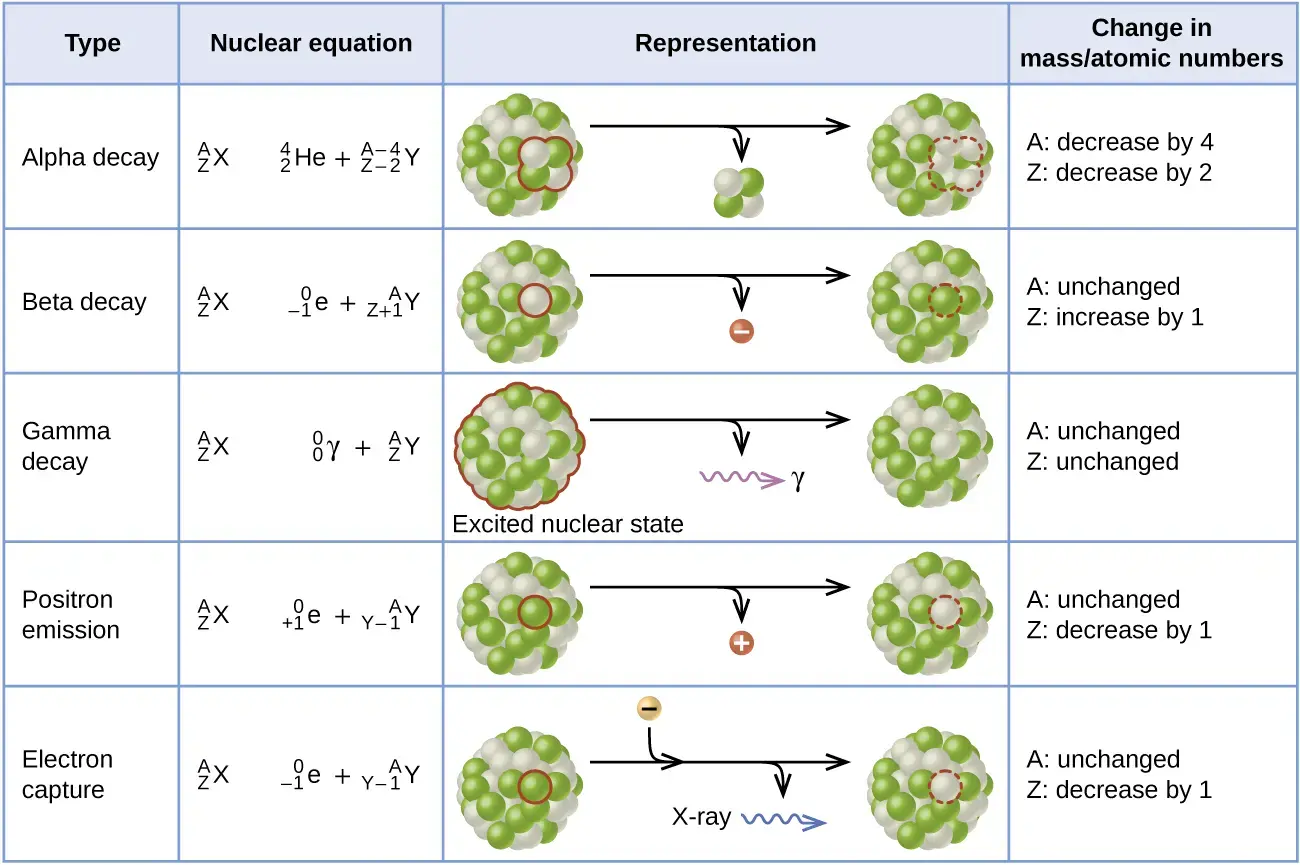
Radioactivity occurs when we have an instability in the nuclear structure of an atom. There’s several different ways in which this can happen:
Change in the number of protons at the center (i.e. change in Z)
Not only would we add protons or lose protons, but we’re also changing the chemical nature.
3 major processes that this can occur:
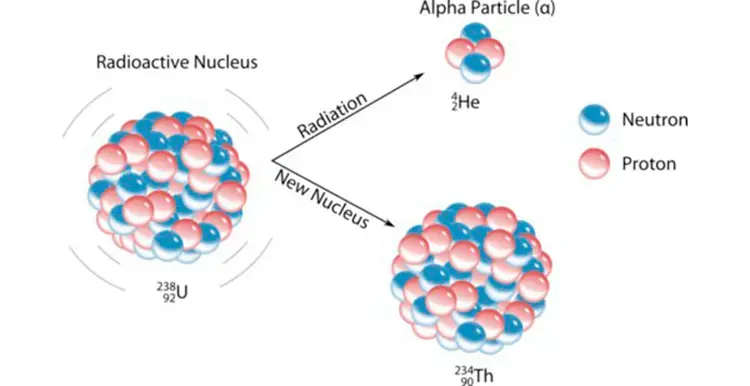
Alpha decay
Where a cluster of protons and neutrons (e.g. 24He) are expelled from the nucleus.
Common in very large atoms, such as uranium and plutonium.
Beta decay
Where either a proton sheds a positron (or a neutron sheds an electron), i.e. shed a little bit of charge either in the positive sense or in the negative sense → Z increases or decreases by 1, respectively, but A remains unchanged.
Does NOT change the number of nucleons, but it does change the amount of charge in the center of the nucleus.
Electron Capture
Electron cloud passes close by a large nucleus → grabs an electron from the electron cloud + a proton is changed to a neutron
Isomeric transitions: No change in the number of protons, i.e. no change in Z
Gamma Decay
We have an atom that maybe starts to raise its energy state → goes to a low energy state with no change in the number of nucleons or the number of protons at the center of it, but gives off energy and conserves energy → produces a gamma ray that then detected by the system
Calculating the number of radioactive atoms in a sample
Is proportional to the number of atoms present
The change in the number is proportional to a constant (k, sometimes written as λ) times the number that’s present. When we integrate that we end up with the familiar exponential decay.
dtdN=−kN → Integration of this is ∫NdN=−k∫dt
N=N0⋅exp(−kt)
Example: We have a five millicary (mCi) dose of technitium that spilled on the floor carpet in the in a laboratory. And with a half life of 72 hours, how long must we wait to reach 1/1,000th of the activity remaining?
Dose=Dose0⋅exp(t1/2−t⋅ln(2))
t=ln(2)t1/2⋅ln(1,000) = 717 hours
Compton Scattering
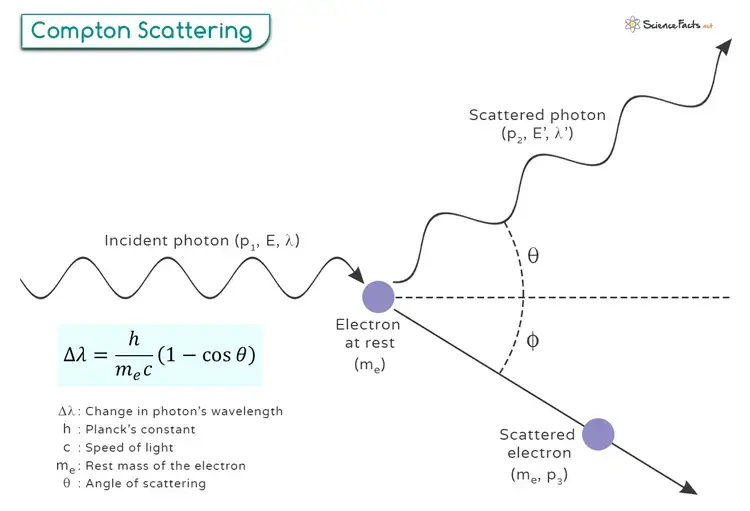
The way that Compton scattering takes place is an incident photon scatters off an electron in the electron cloud and the photon heads off in a new direction and kicks out an electron into the media.
The amount of energy change is determined by the Compton formula.
The new energy is largely determined by the incident energy and the angle.
Higher incident energy → bigger energy change energy change
Higher unit angle → bigger energy change
Example: A technologist opens the 140 keV photon window to +/-14 keV (20%). What is the minimum single scattering angle that the energy window can reject (assume perfect energy resolution and mc2 = 511 keV?